
Hail that bruises shingles usually hits the walls, gutters and trim too, hardest on the side of the house that faced the storm. PCG Roofing repairs and replaces siding in San Antonio, Converse and Laredo, so the walls get put right along with the roof instead of turning into a separate project with a separate company months later.
Maybe your siding took the September 11, 2026 hail in east San Antonio, or the September 4 and 5 hail in northwest Laredo. Maybe it has simply been baking in the sun for years. Either way, it starts with a free inspection: we look at the walls up close and show you what we see.
Richard, the owner, tells you what the walls need and why. The job goes into a plain-English contract, so you know exactly what's being done to your house before work begins.
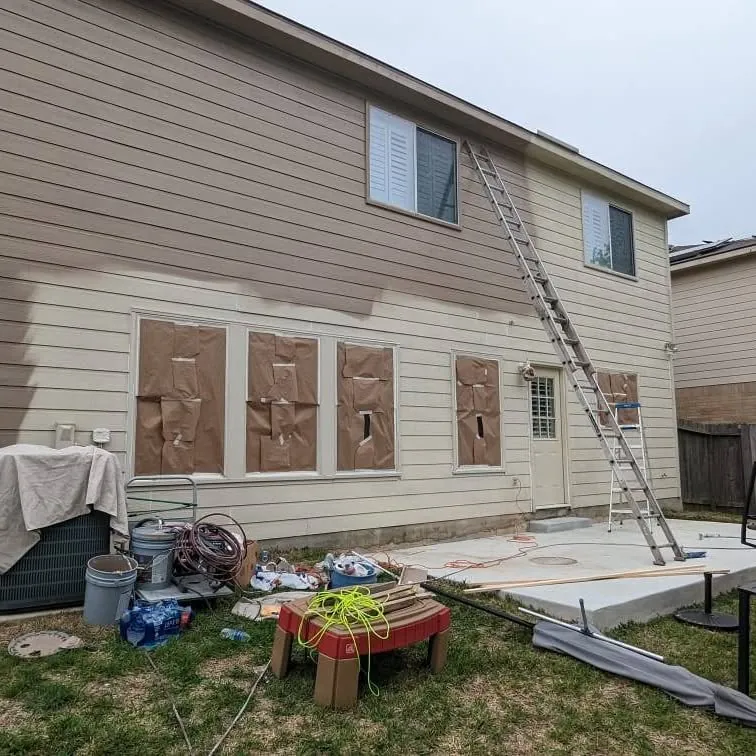
Vinyl, Fiber Cement or Engineered Wood Siding
Most siding on homes around San Antonio falls into a few families. Each has trade-offs, and the right one depends on the house, the budget and how long you plan to stay. What follows is general background on the materials, not a claim about any one product.
Vinyl siding
Vinyl is the most common siding on newer homes around San Antonio and Converse. It is light, it never needs paint, and it comes in a wide range of colors and profiles. The trade-off is that years of strong sun make it brittle, and brittle vinyl is what hail cracks most easily.
Fiber cement siding
Fiber cement is made from cement, sand and wood fibers, pressed into boards that look like painted lap siding. It is heavy and rigid, it resists fire, and it stands up to sun and impact better than vinyl. It is painted, so it needs repainting over the years, and it is heavier work to install. For sourced prices, see our guide to fiber cement siding cost.
Engineered wood siding
Engineered wood is made from wood strands or fibers bonded with resin and given a protective coating. It has the look of real wood at a lighter weight than fiber cement. Like any wood product, it depends on its paint and its sealed edges, so chips and gaps need attention before moisture gets in.
What Hail and Sun Do to Siding
Each siding material fails in its own way.
Cracked and holed vinyl
Vinyl flexes in normal weather, but a hard hailstone can crack it or punch a hole straight through. Vinyl that's been baking in the Texas sun for years turns brittle and breaks more easily. The cracks are often small, sit at the bottom edge of a panel, and are easy to miss from the yard. Once there's a hole, rain can get behind the siding.
Dented aluminum and metal trim
Aluminum siding, fascia wraps and window trim dent rather than crack. The dents may not let water in right away, but they show every time the light hits the wall. On painted metal, the impact can chip the finish and leave bare spots.
Chipped fiber cement and split wood
Fiber cement is hard, but a big enough stone can chip corners and edges or crack a board. Wood siding and trim can split, and every chip in the paint on wood lets moisture into the grain.
Gutters and downspouts
Hail dents gutters along the front edge. A splash block full of shingle granules after a storm is also one of the few roof clues you can spot from the ground.
Slow sun damage
Sun does its damage slowly. Vinyl fades unevenly, so the west and south walls can end up a different shade from the shaded sides. Caulk joints around windows and trim dry out and pull away, which opens a path for water behind the siding.
Should You Repair or Replace Your Siding?
A repair makes sense when the damage is limited: a few cracked panels on one wall, a dented corner, a split trim board. Replacement makes more sense when the damage runs across several walls, when the siding is brittle everywhere, or when water has already gotten behind it.
Older siding can be hard to match, and even the same product looks different next to panels that have weathered for a decade. Siding colors and profiles also change over the years, so the exact siding on a house built twenty years ago may not be made anymore. That matters most when only a few panels on a wall are damaged.
Painted siding, like fiber cement and wood, can often be brought back together with a fresh coat once the damaged boards are replaced. That is where our exterior painting work comes in.
How the Free Inspection and Quote Work
We walk the outside of the house and look at the siding, trim, gutters and paint up close. Hail damage is usually worst on the side that faced the storm, so we check every wall, not just the front. If the walls came through fine, we say so.
If there is work to do, you get a written quote after the inspection. Customers say Richard took the time to explain the work and taught them along the way, so you will know what each option involves before you choose one.
What a siding job costs depends on the material, how many walls need work, whether trim and gutters are part of it, and what turns up under the old panels. That is why the quote comes after the inspection rather than over the phone.
Hail-Damaged Siding and Insurance
If the walls took hail, filing a claim is your call. The claim is between you and your insurer. If you file, we can meet the adjuster at your house, and the adjuster works for your insurance company.
Our insurance claims page lays out the process in order, and our hail and storm damage page covers what hail does to the roof itself.
Roof and Walls, One Crew
Siding fits naturally with a roof replacement. Doing them together means one company on your property, one schedule to plan around, and a house that looks finished when the job is done. If you have rooftop solar, see solar panel removal and reinstall.
- The whole exterior at once. Roof, siding and paint from one company, so the storm repairs finish together.
- A free inspection. It costs nothing to find out what the hail or the sun did to your walls.
- Patient explanations. Richard explains what the siding needs in plain English, and the contract is written the same way.
- A clean property. Customers mention a crew that works quickly and leaves the property clean.
We work in San Antonio, Converse and Laredo, 7 days a week, 8 AM to 9 PM. Call (210) 598-8556 or send the form to set up a free inspection of your siding and roof.