
Hail damage is hard to judge from the ground. A roof that took a beating can look perfectly normal from the driveway, while the shingles up top are bruised, cracked or stripped of granules. That's why the first step after a storm is an inspection on the roof itself, by someone who knows what hail marks look like.
On September 11, 2026, hail up to 1.5 to 1.75 inches hit east San Antonio, including Converse, Kirby, China Grove and St. Hedwig. A week earlier, on September 4 and 5, hail hit northwest Laredo and Ranchos Penitas West. Not sure whether the storm got your roof? Start with a free inspection.
We show you what we found, and if the roof came through fine, we say so.
What Hail Does to a Roof
Bruised and cracked shingles
A hailstone hitting an asphalt shingle can crack the mat inside it even when the surface looks only scuffed. The spot feels soft when pressed, a little like a bruise on fruit. Over the following months, that weak spot loses granules and lets sun and water reach the asphalt, so damage that was invisible in September can turn into a leak later.
Granule loss
Hail knocks the protective granules off shingles in scattered spots. Look in your gutters and at the bottom of your downspouts: a heavy layer of granules after a storm is a sign the roof took hits. In Texas heat, a shingle that has lost its granules breaks down much faster than one that hasn't.
Dents in metal and soft surfaces
Hail marks softer metals before it shows on shingles. Dents in roof vents, gutters, downspouts and the fins of an outdoor air conditioning unit are clues that hail of a meaningful size fell on your property. Window screens and painted surfaces often show it too.
Siding, paint and other exterior damage
Wind-driven hail hits walls as well as roofs. We inspect the whole exterior, and we do siding and exterior painting as well as roofs.
Wind damage
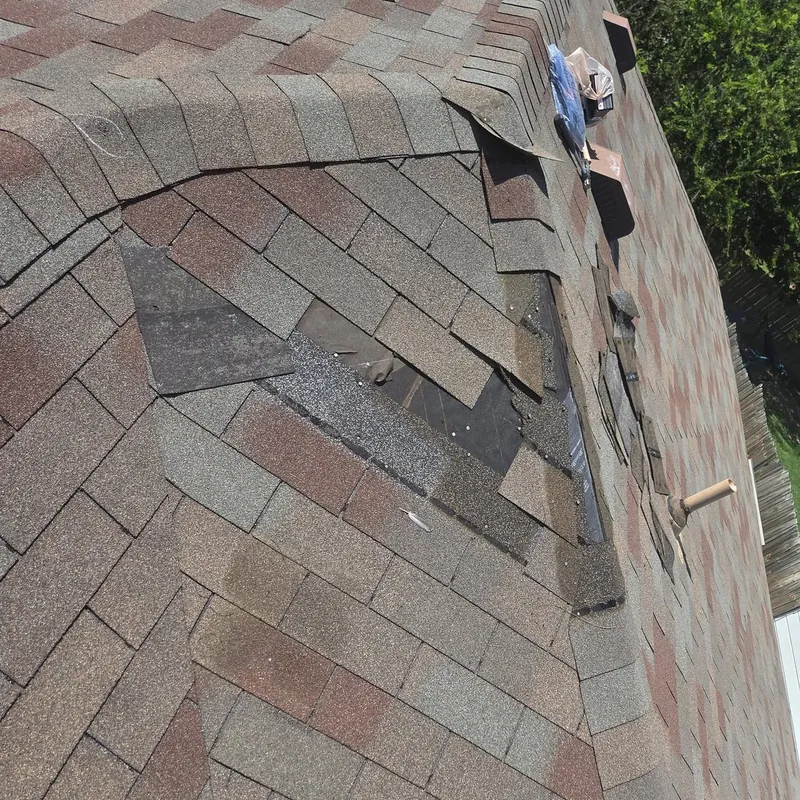
The strong winds that come with a South Texas thunderstorm can lift shingles, break the seal strips that hold them down and tear some off entirely. Wind tears shingle tabs loose along the edges and ridges first, leaving bare strips where the layer underneath is exposed to sun and rain. Lifted shingles can lie back down after the wind passes, which is another reason damage gets missed from the ground.
Choosing a Roofer After the Storm
Whoever knocked first, a few things are worth checking before you sign anything, with us or anyone else:
- Real reviews from real customers. Look the company up on Google and read what people wrote. Ours go back to 2018: 11 Google reviews and a 4.5-star rating.
- A contract you can read. Ours are written in plain English. Take any contract home and read it before you sign.
- Someone who explains instead of pressuring. A good roofer explains how things work and leaves the decisions to you.
Texas law also limits what a roofing contractor can do on an insurance job. Texas Insurance Code §4102.163 bars a contractor from acting as a public adjuster on a property it works on, so be careful with anyone who promises to take over your claim or speak to your insurer for you. Read more on our insurance claims page.
How a Storm Damage Job Works With Us
1. A free inspection
We get on the roof and look at the shingles, vents, flashing and gutters up close.
2. The claim process, explained
If there's damage, we explain the steps: the adjuster's visit, the insurer's decision and when payments usually come.
3. The adjuster visit
If you file, your insurance company sends an adjuster, and we can be at the house when the adjuster looks at the roof. The adjuster works for your insurance company.
4. The work
If your insurer approves the work, we build to the approved scope, under a written contract you've read first. Customers mention a crew that works quickly and leaves the property clean.
5. Through to the end
Insurance payments on a roof often arrive in more than one installment, and the last one can take a while. We stay until the job is finished and paid for.
Why Timing Matters After a Hail Storm
Hail damage gets worse, not better. A bruised shingle keeps losing granules every time it rains and bakes every afternoon in the sun, and a crack that lets in a little water this winter lets in more by next summer. Waiting also makes it harder to tie the damage to one specific storm.
Insurance policies can set time limits for reporting storm damage, and those limits vary from policy to policy. Check your own policy, or ask your insurance company, so you know your deadline. An inspection now tells you whether there's anything to think about at all.
A Straight Answer, Whoever Knocked First
- The owner answers. Your call or form goes to Richard, the owner. We pick up 7 days a week, 8 AM to 9 PM.
- Patience with first-timers. Our reviews come from homeowners who had never filed a claim and were worried about scammers. They remember the patient explanations.
- Roof, solar, siding and paint. If panels need to come off, we handle the solar panel removal and reinstall, and we do siding and exterior painting too.
- Near the storm? See our Converse and Laredo pages, or call (210) 771-4631.